Lubricants and waxes
Base Oil Group III
Group III base oils are hydroprocessed mineral oils with at least 90 percent saturates and sulphur at or below 0.03 percent. They are the main base stock for modern engine oils.
← Todos os produtosTambém chamado de: Group III base oil, Hydroprocessed base oil
- Ponto de fulgor200 to 250 C typical (open cup)
- Densidade840 to 870 kg/m³
- ViscosidadeAbout 4 to 10 mm2/s at 100 C depending on grade
- Fluidez a frio-12 to -18 C typical
- EnxofreLess than 0.03% (often below 10 ppm)
- Faixa de ebulição300 to 550 °C
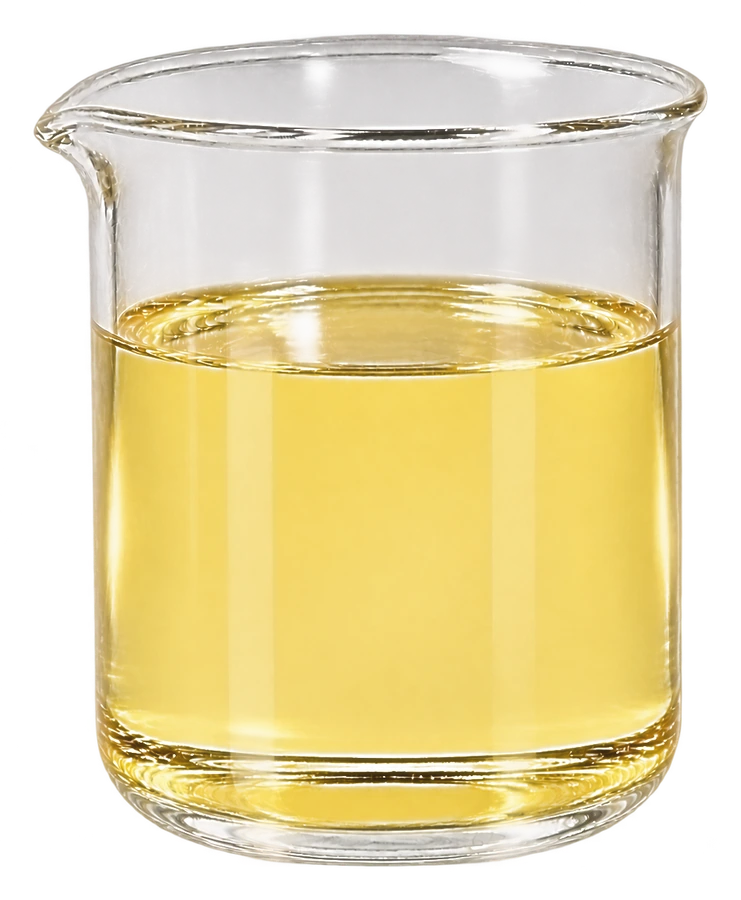
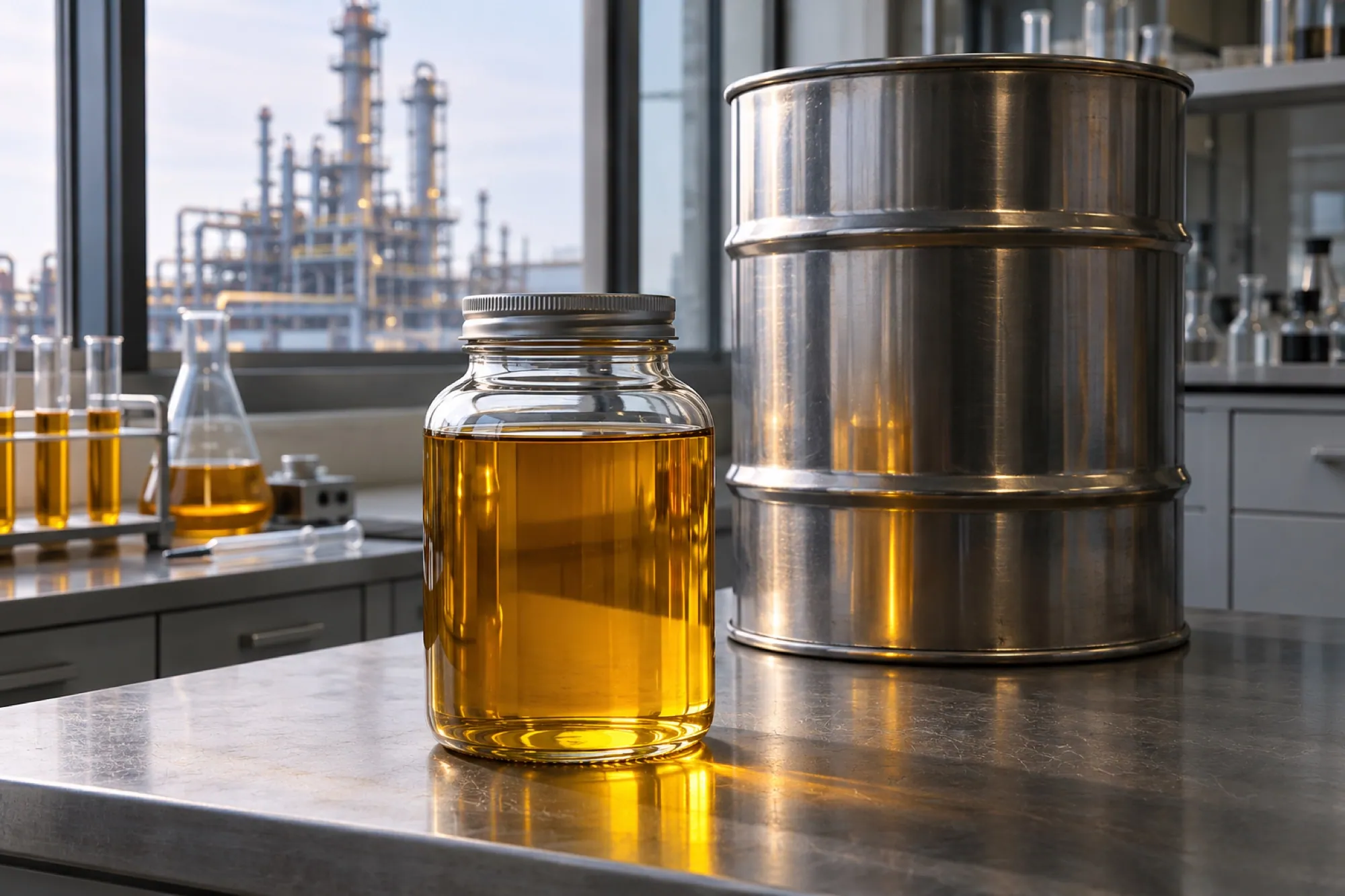
Créditos das imagens As amostras em vidro de laboratório foram feitas a partir de fotografias de referência da Wikimedia Commons por Chemik10 (CC BY-SA 2.5) e uma foto de amostra de petróleo em CC0.
Agite o líquido para sentir a sua espessura
Passe o rato ou um dedo sobre o líquido. Prima e arraste para agitar com mais força. Teclado: as setas agitam, a barra de espaço sacode.
Espesso Pesado. Resiste à agitação e só se move devagar.
Viscosidade típica segundo os dadosAbout 4 to 10 mm2/s at 100 C depending on grade
- Velocidade de agitação
- 0 px/s
- Movimento do líquido
- 0%
- Assentou após
- -
- Superfície
- Parado
A classe é apenas uma referência de sensação. O valor de viscosidade apresentado é o dos dados da especificação.
Aspecto esperado
Water-white to pale yellow
Onde é usado
- Engine oils (SAE 5W-30, 10W-40)
- Hydraulic and turbine oils
- Gear oils
- Transformer oils
Manuseamento e segurança
- Store in clean, dry closed tanks away from heat. Keep different grades separate to avoid contamination. Sample per ASTM D4057; inspect colour, viscosity, flash point and water. Drums, IBCs and flexitanks are common packaging.
- Combustible at high temperature. Hot product causes burns. Low acute toxicity; mist inhalation and prolonged skin contact should be avoided.
Propriedades típicas
- Aparência
- Water-white to pale yellow
- Densidade a 15 °C
- 840 to 870 kg/m³
- Faixa de ebulição
- 300 to 550 °C
- Ponto de fulgor
- 200 to 250 C typical (open cup)
- Viscosidade
- About 4 to 10 mm2/s at 100 C depending on grade
- Ponto de fluidez
- -12 to -18 C typical
- Enxofre típico
- Less than 0.03% (often below 10 ppm)
◉What it is
Group III oils have at least 90 percent saturates, no more than 0.03 percent sulphur and a viscosity index of at least 120 (Wikipedia). They are made by hydroprocessing rather than solvent extraction, so they are clearer, more stable and more consistent than Group I. Group III is widely used for passenger car and heavy-duty engine oils. Viscosity grades are given in cSt at 100 C or by Neutral numbers such as N 100, N 150 or N 600.
⬡What it is made of
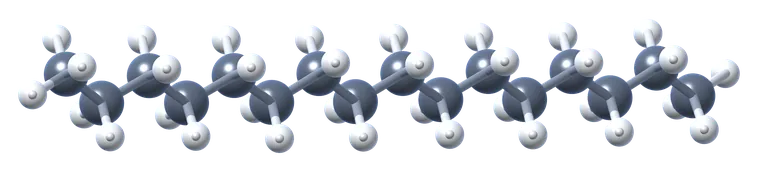
C20 to C40 saturated paraffins and naphthenes.
⚛A química
Hydrogenation saturates aromatic rings and removes sulphur and nitrogen, leaving cycloalkanes and isoparaffins. Branched isoparaffins give low pour point and good viscosity index; saturated structure improves oxidation stability.
⚙How it is made
Vacuum gasoil is hydrocracked and hydroisomerised vacuum distillate, with VI raised by isomerising wax.
▶How it works
Base oil forms the bulk of the lubricant and provides film thickness, heat transfer and solvency for additives. Higher saturates and viscosity index give longer drain intervals.
▣Storage, loading and inspection
Store in clean, dry closed tanks away from heat. Keep different grades separate to avoid contamination. Sample per ASTM D4057; inspect colour, viscosity, flash point and water. Drums, IBCs and flexitanks are common packaging.
★Why it matters in the Gulf
Group II and III base oils are traded into the region for lubricant blending, including blending plants at Jebel Ali. Gulf production plants are not stated.
Moléculas principais

Normas e especificações
| API 1509 | Group classification |
|---|---|
| ASTM D445 and D2270 | Viscosity and VI |
| ACEA and ILSAC | Engine oil standards that drive demand |
Riscos
Combustible at high temperature. Hot product causes burns. Low acute toxicity; mist inhalation and prolonged skin contact should be avoided.
Como é negociado
Units
Metric tonnes; drums; flexitanks
Benchmarks
Platts Group II and III base oil assessments FOB Arab Gulf, Asia and Europe
Typical cargo
Parcels of 1,000 to 10,000 mt; containerised lots
Incoterms
FOB, CFR, CIF; drums and ISO tanks FCA or DAP
Notes
Group III is also called VHVI or hydrocracked base oil.
Refinarias que o produzem: nossas sugestões
38 refinarias listadas produzem este produto, 18 delas no Golfo, no Irã e no Iraque. Ordenamos primeiro as unidades do Golfo, depois as em operação e, por fim, por capacidade.
- 1Ruwais Refinery
 United Arab Emirates · 922,000 bpdLargest capacity among Gulf-first matchesGulf locationOperatingDeep conversionAcesso de exportação
- 2Daura Refinery
 Iraq · 140,000 bpdGulf locationOperating
- 3Pearl GTL
 Qatar · 140,000 bpdGulf locationOperatingAcesso de exportação
- 4Najaf Refinery Iraq · 30,000 bpdGulf locationOperating
- 5Bahrain Lube Base Oil Plant (BLBOC)
 Bahrain · 8,000 bpdGulf locationOperatingAcesso de exportação
- 6Sepahan Oil Company
 Iran · Not publishedGulf locationOperatingAcesso de exportação




Terminais que o movimentam
- Gulf Petrochem Hamriyah terminal United Arab Emirates
- Regal Petro Trading terminal, Hamriyah United Arab Emirates
- Sharafco Petroleum terminal, Hamriyah United Arab Emirates
- Sharlu base oil terminal, Hamriyah United Arab Emirates
Você sabia
💡 Group III is marketed by some blenders as synthetic technology although it is mineral-based.
💡 Group III oils are fully produced by hydrocracking, hydroisomerisation and hydrotreating (Wikipedia).
Teste seus conhecimentos sobre Base Oil Group III
What is the VI of Group III?
Mais neste grupo
- Base Oil Group I (SN 150, SN 500, Bright Stock)
- Base Oil Group II
- White Oil (Medicinal and Technical)
- Paraffin Wax
- Slack Wax
Fontes
Redigido com as palavras da própria PST a partir das fontes acima. Confiabilidade dos dados: medium. Os valores típicos variam conforme a origem e o contrato, por isso leia sempre a especificação do seu próprio contrato.