Solvents and specialities · API Group I base oils, trade basis
Base oils SN 150 and SN 500
Solvent-neutral base oils are the main ingredient of lubricants. The number is the approximate viscosity grade: SN 150 is thin, SN 500 is thicker. They are Group I oils: less than 90% saturates and/or more than 0.03% sulphur, with a viscosity index of 80 to 119.
- 7Parameters
- 5With a limit
- 7Off-spec causes explained
- Flash pointmin 200 °C
- Viscosity5 to 5.8 mm²/s
- Cold flowmax -6 °C
- Sulphurreport % m/m
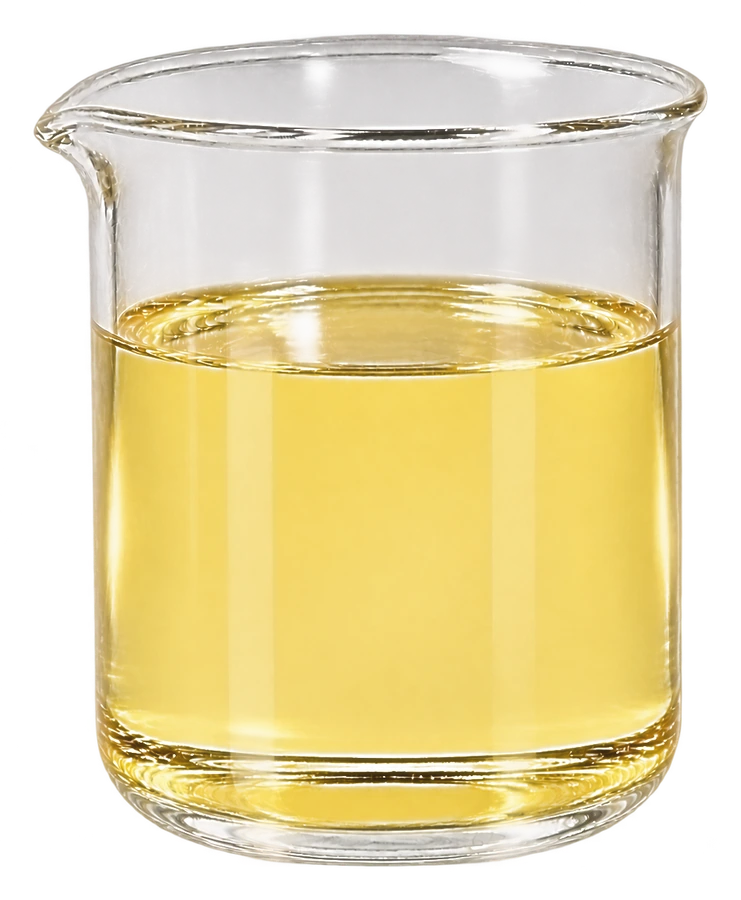
Image credits Laboratory glass samples are made from reference photos on Wikimedia Commons by Chemik10 (CC BY-SA 2.5) and a CC0 petroleum sample photo.
Stir the liquid to feel how thick it is
Move the mouse or a finger across the liquid. Press and drag to stir harder. Keyboard: arrow keys stir, Space shakes.
Thick Heavy. It resists the stirring and only moves slowly.
Typical viscosity from the dataViscosity at 100 °C, SN 150: 5 to 5.8 mm²/s
- Stir speed
- 0 px/s
- Liquid movement
- 0%
- Settled after
- -
- Surface
- Still
The class is a guide for feel. The viscosity figure shown is the one in the specification data.
How it looks
ASTM D1500 colour scale
Clear, from pale yellow to amber. The colour is graded on the ASTM D1500 scale, and a darker colour means a poorer or more oxidised oil. Bright and free of haze is required.
Where it is used
- Engine and gear oils
- Industrial and hydraulic oils
- Greases and process oils
Handling and safety
- Clean, dry storage with no cross-contamination between grades.
- A certificate for every batch, with viscosity at 40 and 100 °C.
Typical properties
- Colour
- max 3.5 ASTM D1500
- Flash point (COC), SN 150
- min 200 °C
- Viscosity index
- min 90
- Pour point
- max -6 °C
- Viscosity at 100 °C, SN 150
- 5 to 5.8 mm²/s
Compare the grades
SN 150, SN 500 and bright stock are all Group I oils from the same solvent refining route. The difference is how heavy the cut is, and that sets viscosity, colour and use.
SN 150Light neutral
The thinnest of the three. It comes from the lighter vacuum distillate, so it is also the palest. It flows easily and suits oils that must work in the cold or at low viscosity.
- Viscosity at 40 °C
- about 29 to 32 mm²/s
- Viscosity at 100 °C
- about 5.2 to 5.5 mm²/s
- Viscosity index
- about 95 to 100
- Flash point (COC)
- about 200 to 220 °C
- Pour point
- about -9 to -12 °C
- Colour, ASTM D1500
- 0.5 to 1.0 (lightest)
Colour on the ASTM D1500 scale
Where it is used
- Hydraulic and industrial oils
- Light engine oil blends
- Process and transformer oils
Thickness compared (viscosity at 40 °C)
Bars use a log scale, because bright stock is about 15 times thicker than SN 150.Why heavier means darker
Colour bodies are large aromatic and polar molecules. They sit in the heavy end of the crude, so a heavier cut carries more of them, and solvent refining cannot remove all of it.
Colour is a check, not a grade
ASTM D1500 colour tells you how well a batch was refined and whether it has oxidised. A batch that is darker than its usual range is a warning, even if viscosity is right.
Group II and III look different
Hydrocracked and hydrotreated oils are almost water-white and have a higher viscosity index. They are not Group I, so they use other names (such as N 150) and other prices.
Typical figures for Group I oils, for understanding only. Always use the producer's data sheet and your contract.
The specification
API Group I base oils, trade basis. Limits are the commonly published ones. Your contract and the current edition of the standard decide.
| Parameter | Limit | Test method | What it protects |
|---|---|---|---|
| Colour | max 3.5 ASTM D1500 | ASTM D1500 | A darker oil has been refined less or has oxidised. |
| Flash point (COC), SN 150 | min 200 °C | ASTM D92 | Safety and volatile content of the oil. |
| Viscosity index | min 90 | ASTM D2270 | How stable the viscosity is as temperature changes. |
| Pour point | max -6 °C | ASTM D97 | Cold flow in the field. |
| Viscosity at 100 °C, SN 150 | 5 to 5.8 mm²/s | ASTM D445 | Sets the grade (the SN number). |
| Sulphur | report % m/m | ASTM D4294 | Above 0.03% the oil is Group I. |
| Saturates | report % m/m | ASTM D2007 | Below 90% is Group I. |
Why a cargo goes off spec
When one parameter fails, it usually points to one cause. Here is what to look for.
Colourmax 3.5 ASTM D1500
Too highPoor solvent refining, oxidation or contamination.
Why it mattersA darker oil has been refined less or has oxidised.
Flash point (COC), SN 150min 200 °C
Too lowLight ends left in after stripping, or contamination with lighter oil.
Why it mattersSafety and volatile content of the oil.
Viscosity indexmin 90
Too lowPoor extraction or a naphthenic cut.
Why it mattersHow stable the viscosity is as temperature changes.
Pour pointmax -6 °C
Too highInsufficient dewaxing.
Why it mattersCold flow in the field.
Viscosity at 100 °C, SN 1505 to 5.8 mm²/s
Too highCut too heavy or mixed with a heavier oil.
Too lowCut too light.
Why it mattersSets the grade (the SN number).
Sulphurreport % m/m
Too highLess refined oil.
Why it mattersAbove 0.03% the oil is Group I.
Saturatesreport % m/m
Too lowA less refined or aromatic oil.
Why it mattersBelow 90% is Group I.
Check your own certificate
Type the values, paste the certificate text, or upload a PDF or photo. The checker names every parameter that is off spec and the usual reason.
| Parameter | Limit | Your value | Result |
|---|---|---|---|
| ColourASTM D1500 | max 3.5 ASTM D1500 | enter a value | |
| Flash point (COC), SN 150ASTM D92 | min 200 °C | enter a value | |
| Viscosity indexASTM D2270 | min 90 | enter a value | |
| Pour pointASTM D97 | max -6 °C | enter a value | |
| Viscosity at 100 °C, SN 150ASTM D445 | 5 to 5.8 mm²/s | enter a value | |
| SulphurASTM D4294 | report % m/m | enter a value | |
| SaturatesASTM D2007 | report % m/m | enter a value |
Sources
Indicative information for professional users. Not a substitute for the standard, a contract or an independent inspector.