Lubricants and waxes
Base Oil Group I (SN 150, SN 500, Bright Stock)
Group I base oils are solvent-refined mineral oils with less than 90 percent saturates and/or more than 0.03 percent sulphur, and a viscosity index of 80 to under 120. SN 150, SN 500 and bright stock are common viscosity grades.
← All productsAlso called: Group I base oil, Solvent refined base oil, SN 150, SN 500, Bright stock, Solvent neutral
- Flash pointSN 150 about 210 C; SN 500 about 240 C; bright stock about 290 C (open cup)
- Density860 to 900 kg/m³
- ViscositySN 150: about 30 mm2/s at 40 C; SN 500: about 100 mm2/s at 40 C; bright stock: about 30 mm2/s at 100 C
- Cold flowSN 150 about -9 C; SN 500 about -9 to -6 C; bright stock about -6 C to 0 C
- Sulphur0.03% to 1% (above 0.03% by definition)
- Boiling range300 to 600 °C
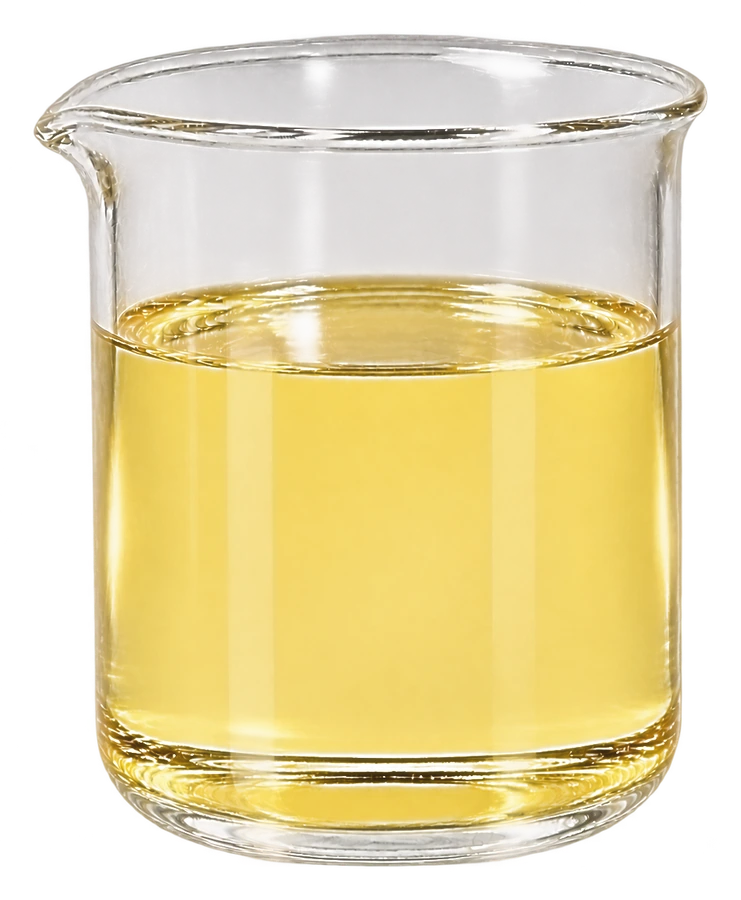
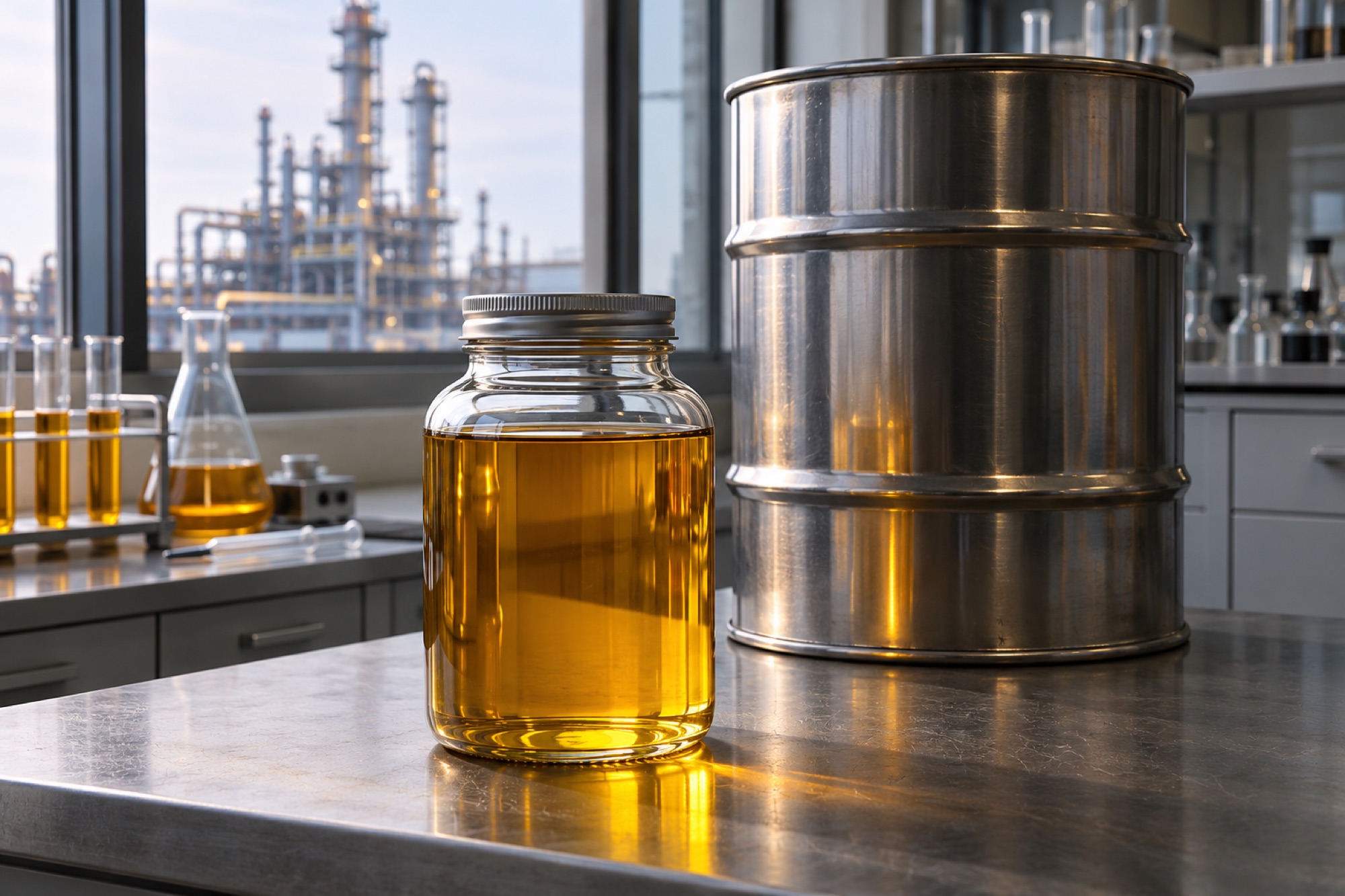
Image credits Laboratory glass samples are made from reference photos on Wikimedia Commons by Chemik10 (CC BY-SA 2.5) and a CC0 petroleum sample photo.
Stir the liquid to feel how thick it is
Move the mouse or a finger across the liquid. Press and drag to stir harder. Keyboard: arrow keys stir, Space shakes.
Thick Heavy. It resists the stirring and only moves slowly.
Typical viscosity from the dataSN 150: about 30 mm2/s at 40 C; SN 500: about 100 mm2/s at 40 C; bright stock: about 30 mm2/s at 100 C
- Stir speed
- 0 px/s
- Liquid movement
- 0%
- Settled after
- -
- Surface
- Still
The class is a guide for feel. The viscosity figure shown is the one in the specification data.
How it looks
Light yellow to amber, bright
Where it is used
- Engine oils (older formulations)
- Industrial and marine lubricants
- Greases
- Metalworking fluids
- Rubber process oils
Handling and safety
- Store in clean, dry closed tanks away from heat. Keep different grades separate to avoid contamination. Sample per ASTM D4057; inspect colour, viscosity, flash point and water. Drums, IBCs and flexitanks are common packaging.
- Combustible at high temperature. Hot product causes burns. Low acute toxicity; mist inhalation and prolonged skin contact should be avoided.
Typical properties
- Appearance
- Light yellow to amber, bright
- Density at 15 °C
- 860 to 900 kg/m³
- Boiling range
- 300 to 600 °C
- Flash point
- SN 150 about 210 C; SN 500 about 240 C; bright stock about 290 C (open cup)
- Viscosity
- SN 150: about 30 mm2/s at 40 C; SN 500: about 100 mm2/s at 40 C; bright stock: about 30 mm2/s at 100 C
- Pour point
- SN 150 about -9 C; SN 500 about -9 to -6 C; bright stock about -6 C to 0 C
- Typical sulphur
- 0.03% to 1% (above 0.03% by definition)
◉What it is
Group I is the oldest and least refined API base oil category. It is made from vacuum distillates and deasphalted residue using solvents to remove aromatics and wax. API defines it as having less than 90 percent saturates and/or more than 0.03 percent sulphur, with a viscosity index of 80 to under 120 (Wikipedia). SN means solvent neutral, and the number is roughly the viscosity in Saybolt seconds at 100 F: SN 150 is a light grade, SN 500 a medium-heavy grade. Bright stock is the heaviest grade, made from deasphalted vacuum residue, with a viscosity of about 30 mm2/s at 100 C.
⬡What it is made of
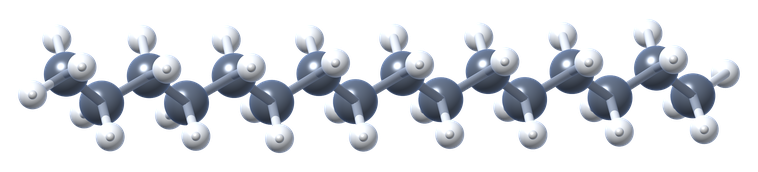
C26 to C40 paraffins, naphthenes and aromatics (Wikipedia: 26 to 40 carbon fraction).
⚛The chemistry
The oil contains branched and cyclic hydrocarbons. Remaining aromatics and sulphur compounds oxidise more easily than saturates, which limits oil life. Solvent refining removes polar aromatics, raising viscosity index.
⚙How it is made
Vacuum distillates are extracted with furfural or NMP to remove aromatics, dewaxed with MEK or toluene solvent, and finally hydrofinished. Bright stock comes from propane-deasphalted vacuum residue.
▶How it works
Base oil makes up 70 to 99 percent of a lubricant. Viscosity grade decides film thickness; viscosity index measures how little viscosity changes with temperature; saturates and low sulphur control oxidation stability.
▣Storage, loading and inspection
Store in clean, dry closed tanks away from heat. Keep different grades separate to avoid contamination. Sample per ASTM D4057; inspect colour, viscosity, flash point and water. Drums, IBCs and flexitanks are common packaging.
★Why it matters in the Gulf
Group I base oil supply is concentrated in a few regional lube plants and is shrinking worldwide as Group II and III grow. Gulf plant lists and volumes are not stated.
Key molecules

Standards and specifications
| API 1509 Annex E | Defines base oil groups I to V |
|---|---|
| ASTM D445 | Kinematic viscosity |
| ASTM D2270 | Viscosity index |
Hazards
Combustible at high temperature. Hot product causes burns. Low acute toxicity; mist inhalation and prolonged skin contact should be avoided.
How it is traded
Units
Metric tonnes; drums; flexitanks of 20 to 24 mt
Benchmarks
Platts Group I base oil assessments (SN 150, SN 500, bright stock) FOB Arab Gulf and Northwest Europe
Typical cargo
Parcels of 500 to 5,000 mt on small product tankers; containers
Incoterms
FOB, CFR, CIF; drums and ISO tanks FCA or DAP
Notes
Group I supply is shrinking as refiners shut solvent plants.
Refineries that make it: our suggestions
38 listed refineries make this product, 18 of them in the Gulf, Iran and Iraq. We rank Gulf plants first, then operating plants, then by capacity.
- 1Ruwais Refinery
 United Arab Emirates · 922,000 bpdLargest capacity among Gulf-first matchesGulf locationOperatingDeep conversionExport access
- 2Daura Refinery
 Iraq · 140,000 bpdGulf locationOperating
- 3Pearl GTL
 Qatar · 140,000 bpdGulf locationOperatingExport access
- 4Najaf Refinery Iraq · 30,000 bpdGulf locationOperating
- 5Bahrain Lube Base Oil Plant (BLBOC)
 Bahrain · 8,000 bpdGulf locationOperatingExport access
- 6Sepahan Oil Company
 Iran · Not publishedGulf locationOperatingExport access




Terminals that handle it
- Gulf Petrochem Hamriyah terminal United Arab Emirates
- Regal Petro Trading terminal, Hamriyah United Arab Emirates
- Sharafco Petroleum terminal, Hamriyah United Arab Emirates
- Sharlu base oil terminal, Hamriyah United Arab Emirates
Did you know
💡 Bright stock is the heaviest Group I grade and is used in gear oils and greases.
💡 Group I output is falling worldwide as Group II and III oils gain share.
Test yourself on Base Oil Group I (SN 150, SN 500, Bright Stock)
What do Group I oils have by definition?
More in this group
Sources
Written in PST's own words from the sources above. Confidence in the data: medium. Typical values vary by origin and contract, so always read the specification in your own contract.