Heavy fuels
Residual Fuel Oil (RFO / MFO)
Residual fuel oil is what remains after lighter products are distilled from crude. It is thick, dense and sulphur-rich, and it is burned in ships, boilers and power plants.
← All productsAlso called: Mazut, MFO, Marine fuel oil, Fuel oil No. 6, Bunker C, Black oil
- Flash pointMin 60 C typical (Wikipedia: about 65 C for No. 6)
- Density950 to 1030 kg/m³
- Viscosity50 to 700 mm2/s at 50 C
- Cold flowUp to 30 C
- Sulphur0.5 to 4% typical
- HazardUsually none. Depending on the description and temperature, shippers may use UN3082 or UN3257., Often not classified as dangerous goods for transport (flash point above 60 C). Class 9 if shipped under UN3082 (environmentally hazardous substance, liquid, n.o.s.) or UN3257 (elevated temperature liquid, n.o.s.). Check the supplier's safety data sheet.
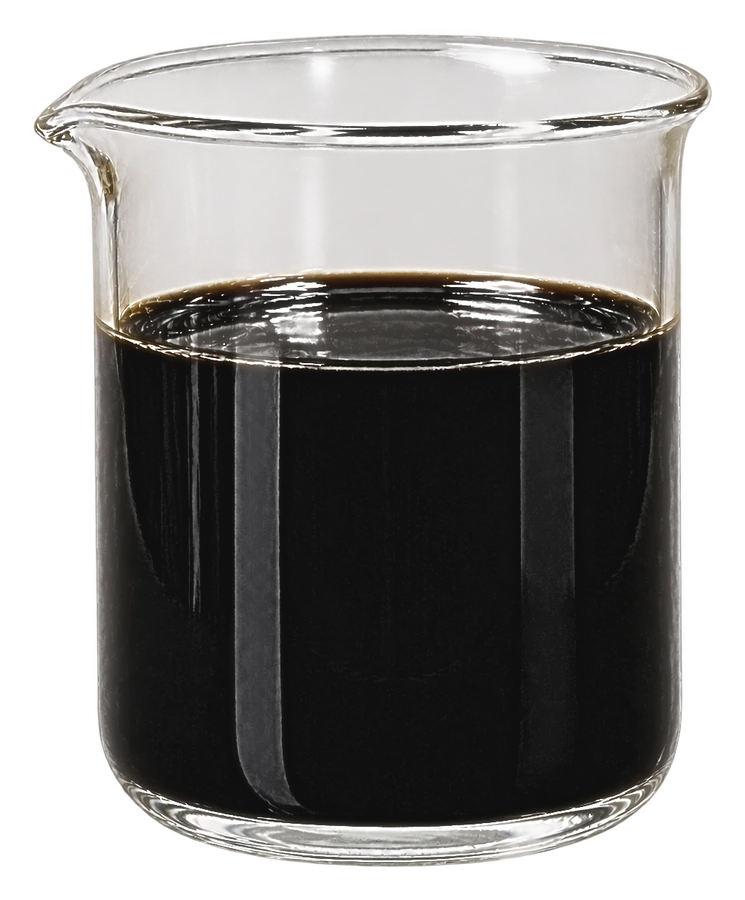

Image credits Laboratory glass samples are made from reference photos on Wikimedia Commons by Chemik10 (CC BY-SA 2.5) and a CC0 petroleum sample photo.
Stir the liquid to feel how thick it is
Move the mouse or a finger across the liquid. Press and drag to stir harder. Keyboard: arrow keys stir, Space shakes.
Very thick Very heavy. It barely moves and flows back slowly.
Typical viscosity from the data50 to 700 mm2/s at 50 C
- Stir speed
- 0 px/s
- Liquid movement
- 0%
- Settled after
- -
- Surface
- Still
The class is a guide for feel. The viscosity figure shown is the one in the specification data.
How it looks
Black, tarry
Where it is used
- Ship fuel
- Power plant fuel
- Industrial boilers
- Cement kilns
Handling and safety
- Store in heated tanks, typically 40 to 50 C for pumping and 100 to 150 C for centrifuge and injection, with the temperature kept at least 10 C above the pour point and below 20 C under flash point. Avoid overheating that causes coking. Check for incompatibility when mixing batches (ASTM D4740 spot test or D7060). Sampling follows ISO 3170 or ISO 3171 with MARPOL retained sample. Inspect for water, catalytic fines (aluminium plus silicon) and total sediment.
- Hot product can cause burns. Residual fuels contain polycyclic aromatics and can release hydrogen sulphide in tank headspace. Spills are very damaging to marine life.
Typical properties
- Appearance
- Black, tarry
- Density at 15 °C
- 950 to 1030 kg/m³
- Flash point
- Min 60 C typical (Wikipedia: about 65 C for No. 6)
- Viscosity
- 50 to 700 mm2/s at 50 C
- Pour point
- Up to 30 C
- Typical sulphur
- 0.5 to 4% typical
◉What it is
Residual fuel oil is the heaviest liquid product of a refinery. It is the vacuum residue or atmospheric residue, usually blended with a lighter cutter stock to adjust viscosity. In the US it is fuel oil No. 6 or Bunker C; in Russia and Central Asia it is called mazut; in power industries it may be called MFO (marine fuel oil or mazut fuel oil). Density is about 0.95 to 1.03 g/cm3 (Wikipedia). It must be heated to flow: No. 6 needs preheating to about 104 to 127 C (Wikipedia). The fuel is cheap but polluting.
⬡What it is made of
C20 to C70+ hydrocarbons: aromatics, naphthenes, resins and asphaltenes, with sulphur, nitrogen and metals.
⚛The chemistry
Residual fuel contains large aromatic and naphthenic molecules, resins and asphaltenes, which are clusters of polycyclic aromatic rings with heteroatoms (S, N, O) and metals such as vanadium and nickel. Asphaltenes make the oil dense and viscous; resins keep them dispersed. Mixing incompatible fuels can precipitate asphaltenes as sludge.
⚙How it is made
Vacuum distillation leaves vacuum residue, which can be visbroken to cut viscosity. The result is diluted with distillates.
▶How it works
Heated, filtered and atomised to burn in boilers and slow engines.
▣Storage, loading and inspection
Store in heated tanks, typically 40 to 50 C for pumping and 100 to 150 C for centrifuge and injection, with the temperature kept at least 10 C above the pour point and below 20 C under flash point. Avoid overheating that causes coking. Check for incompatibility when mixing batches (ASTM D4740 spot test or D7060). Sampling follows ISO 3170 or ISO 3171 with MARPOL retained sample. Inspect for water, catalytic fines (aluminium plus silicon) and total sediment.
★Why it matters in the Gulf
Gulf refineries produce fuel oil and Fujairah stores and blends it. Central Asia uses mazut for power and heating. Volumes are not stated.
Key molecules



Standards and specifications
| ISO 8217 | Marine residual grades |
|---|---|
| ASTM D396 | US fuel oil grades including No. 5 and No. 6 |
| GOST 10585 | Russian mazut specification |
Hazards
Hot product can cause burns. Residual fuels contain polycyclic aromatics and can release hydrogen sulphide in tank headspace. Spills are very damaging to marine life.
How it is traded
Units
Metric tonnes (bunkers priced per mt); barrels for refinery trade at about 6.4 to 6.6 bbl per mt.
Benchmarks
Platts FOB Arab Gulf HSFO 380 and fuel oil 180 assessments
Typical cargo
Tanker parcels 20,000 to 80,000 mt
Incoterms
FOB (load port), CIF or CFR, DAP at bunker port or delivered ex-wharf (barge).
Notes
Often sold by cargo, with large volumes from Gulf refineries.
Refineries that make it: our suggestions
91 listed refineries make this product, 21 of them in the Gulf, Iran and Iraq. We rank Gulf plants first, then operating plants, then by capacity.
- 1Ruwais Refinery
 United Arab Emirates · 922,000 bpdLargest capacity among Gulf-first matchesGulf locationOperatingDeep conversionExport access
- 2Al-Zour Refinery
 Kuwait · 615,000 bpdGulf locationOperatingExport access
- 3Ras Tanura Refinery
 Saudi Arabia · 550,000 bpdGulf locationOperatingDeep conversionExport access
- 4SAMREF Yanbu Refinery Saudi Arabia · 400,000 bpdGulf locationOperatingExport access
- 5Petro Rabigh Refinery Saudi Arabia · 400,000 bpdGulf locationOperatingExport access
- 6Abadan Refinery
 Iran · 400,000 bpdGulf locationOperatingDeep conversionExport access




Terminals that handle it
- Port of Fujairah (anchorage and bunkering) United Arab Emirates
- Ras Tanura terminal Saudi Arabia
- Vopak Horizon Fujairah United Arab Emirates
- Bapco Sitra tank farm and marine terminal
 Bahrain
- Yanbu oil terminals (Red Sea) Saudi Arabia
- VTTI Fujairah United Arab Emirates




Did you know
💡 No. 6 oil is also called Bunker C and needs preheating to about 104 to 127 C (Wikipedia).
💡 Residual fuel oil often has a density close to that of water, from about 0.95 to 1.03 g/cm3.
Test yourself on Residual Fuel Oil (RFO / MFO)
What is mazut?
More in this group
- HSFO 3.5% (High Sulphur Fuel Oil)
- VLSFO 0.5% (Very Low Sulphur Fuel Oil)
- ULSFO 0.1% (Ultra Low Sulphur Fuel Oil)
- IFO 380 and IFO 180
- Bunker Fuel (ISO 8217 Grades)
- Vacuum Gasoil (VGO)
- Vacuum Residue
- Slurry Oil (Decant Oil)
- Cutter Stock
- Furnace Oil
Sources
Written in PST's own words from the sources above. Confidence in the data: medium. Typical values vary by origin and contract, so always read the specification in your own contract.